Arlington Tree Co.
Upper Arlington, Ohio — Tree City USA
Boutique tree care for UA's most cherished properties. Hand tools where possible. Slow, attentive work. By someone who grew up on these streets.
Call or text: (614) 312-2979
Structural pruning, deadwood removal, and canopy shaping. Hand tools first. We work with the tree's natural form, not against it.
Observational diagnosis of pest pressure, fungal issues, structural defects, and decline. Honest evaluation — no upsell.
Early structural pruning prevents costly problems at maturity. The best investment you can make in a tree is when it's young.
Part of the work is helping you see your yard the way an orchardist sees an orchard — who's here, how old, what's missing, what's thriving. A written summary you keep.
When a big job needs a crew, or the utility company wants to hack your canopy, you need someone in your corner who speaks the language. I'll walk the job with you, help you evaluate bids, and make sure the work gets spec'd right. Show up the morning of with Tremont Goodie Shop doughnuts for the guys. Make sure your trees get treated the way they deserve.
Hanging limbs, split leaders, debris on the roof. After a significant storm I reach out to Tree Steward clients first. Walk-ins welcome too — call or text and I'll assess same day when I can.
I think of Upper Arlington as my orchard.
A hundred-tree apple orchard in Pennsylvania was enough to teach me that you can't manage what you don't know. A hundred acres of old-growth forest on the Olympic Peninsula was enough to teach me that the work is never done — only tended. One zip code of mature canopy in Tree City USA is the same covenant, smaller scale.
The trees in 43221 have been here for a hundred years. The families in 43220 are inheriting that legacy, and it needs the same stewardship principles that built the original neighborhoods. That DNA — the sugar maples, the oaks, the sycamores — is what makes UA worth protecting.
Most tree problems don't announce themselves. They build quietly — a pest taking hold, a branch losing attachment, a root zone slowly compacting. By the time you notice, the work is bigger than it needed to be.
The Tree Steward program is a standing relationship. I make my orchard round on a regular schedule — checking in on bugs, watching for what's changed season to season. After a storm I reach out before you have to call.
You get someone who knows your trees. I get a route worth driving.
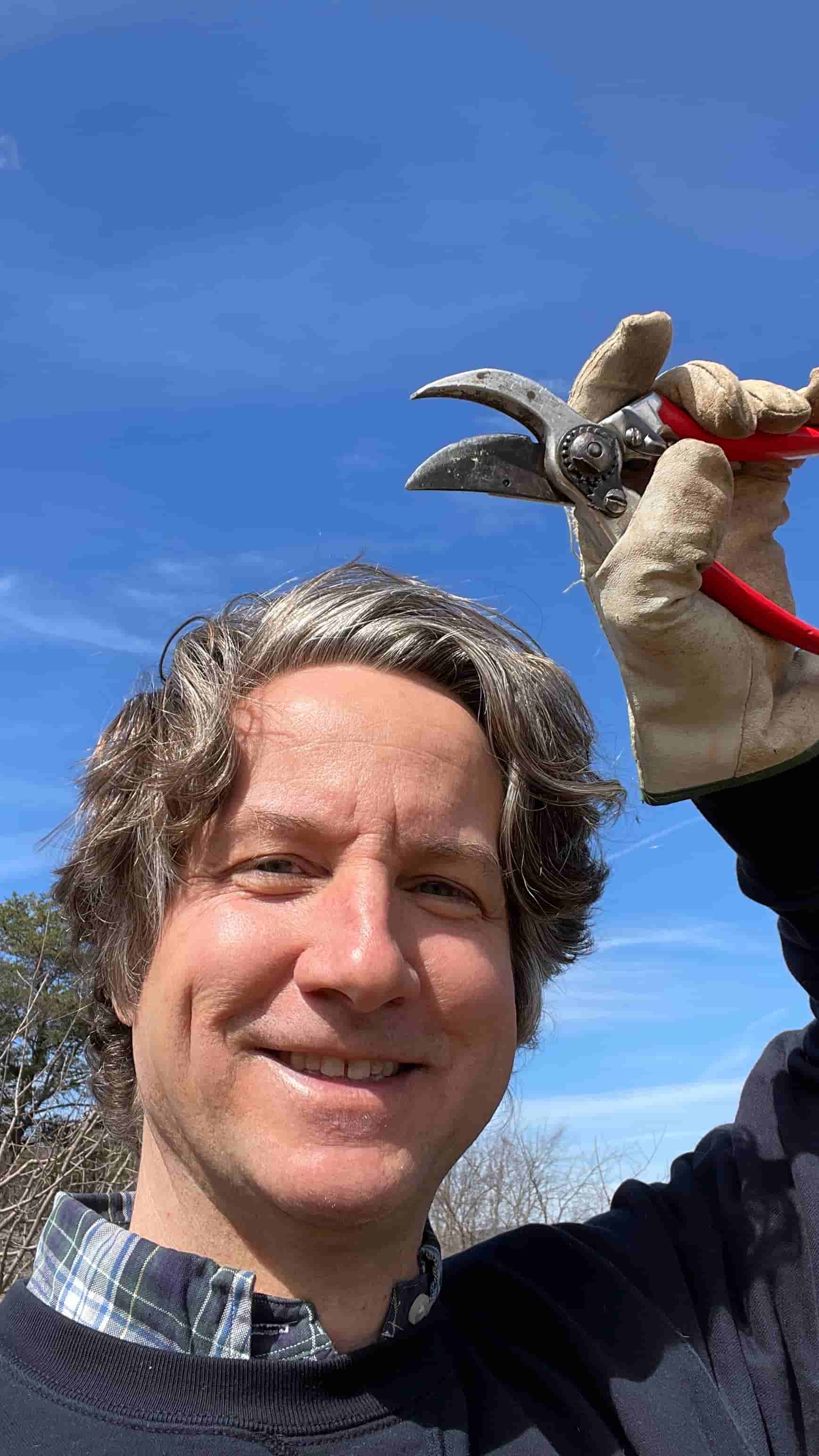
David All · UA '97
I grew up in Upper Arlington — on Henthorn Road, a block from Northam Park, under one of the tallest oak canopies in the city. Tremont Elementary, Jones Middle School, UAHS class of '97. These streets, these yards, these trees shaped me before I knew what to call it. My mom and stepdad planted trees everywhere we lived in UA. They're all thriving today.
I left for a while. What came back with me wasn't a degree — it was an apprenticeship under two men who taught me that a tree is a patient, not a project.
On a 100-acre old-growth property on Washington's Olympic Peninsula, Dave Hahn showed me how to read a forest as a living system. We pruned canopy cover over one of the last natal salmon ponds on the Sol Duc River — every cut in service to the coho fry below. You don't approach work like that with production in mind. You approach it with reverence.
At Laurel Spring Cidery in Pennsylvania, I managed a 100-tree heritage apple orchard under my uncle — an anesthesiologist who treated every cut as surgery. Antiseptic tools. Clean angles. Extraction of a borer the same way you'd respond to a 911 call. I walked that orchard every night, looking for what had changed. I learned to read flood damage, drought stress, oak wilt. I learned that the difference between a tree that lives and a tree that dies is often one attentive person who noticed in time.
Neither man was training a logger. They were training a steward. That's what came home to Upper Arlington.
The tools are half the work. Silky saws, Felco pruners, blades maintained with Yoshihiro Tsubaki oil — the same standard Japanese knife-makers hold their edges to. A few pieces came from my grandfather's collection. Still razor sharp. Still doing exactly what they were built for. Nothing gets replaced until it earns it. When diameter calls for it, a Stihl enters the work — same standard, same intention. Clippings bundled in natural twine, rolled in kraft paper — no plastic touches the yard. Every cut is a wound before it heals. Nothing synthetic touches it. The tree does the rest.
"His goal would be to protect the trees —
carefully inspect and adore each of the leaves."
— David All · Tree Guardian, 2025
Roots
Tremont · Jones · UAHS '97
Upper Arlington born and raised
Field Experience
Orchard management, Laurel Spring Cidery — PA
Old-growth stewardship, Olympic Peninsula — WA
Nature program leader, Millbrook Marsh Nature Center — PA
Certification
ISA Arborist — in progress
Research
Co-author, "Opioid Treatment Deserts"
PLOS ONE · Ohio State University · 2021
Tools & Practice
Silky saws · Felco pruners · Yoshihiro Tsubaki blade oil. Hand-sharpened. A few from Grandpa's collection. The Stihl saw when diameter requires it. Iron mordant + shellac wound treatment — made in-house. Nothing synthetic touches the cut.
Approach
Hand tools first.
Slow work. Done right.
Not Columbus-wide. Not all directions. UA has a distinct character — mature canopy, a community that genuinely cares about its trees, and a Tree City USA designation since 1990. That focus lets us do better work.
The annexation map tells the story. The oldest neighborhoods — Old Arlington, the original plats — carry the deepest canopy. Later annexations filled in around them. The trees track the history. Knowing when a neighborhood was built tells you what's growing there and what it needs next.
Serving zip codes 43220 and 43221.
Tree City USA — Upper Arlington
Annexation Map courtesy of the Upper Arlington Public Library, UA Archives & the City of Upper Arlington
No obligation. Tell me what you're seeing and I'll respond within one business day.